I’m Dr Linda Birkin, a self-employed entomologist based in Nottingham, currently using the description of ‘community entomology’ for my work. I want to bring the fascination and fun of bugs to the widest community of people possible – because insects (and other invertebrates) are important, really interesting, and so often overlooked (metaphorically or otherwise).
I give talks on a wide range of entomology-and-associated topics; I offer bug-focused wildlife activity sessions; and I run workshops for longer, more in-depth education options. Basically, I know a lot about bugs, and I want everyone else to know them better too. Check out the different session pages for more details – or email me questions / comments / booking inquiries.
(I have split up different types of session onto different pages – if you would like a concise overview of what I currently offer, there’s a full spreadsheet list here.)
This is more of a ‘That Is Not How Spiders Work’ post than a lifecycle rework, since I probably am not going to be making a full life cycle for my L. tarantula model (mostly because I can’t currently think of how to do the spiderlings). But wolf spiders are cool, so let’s get into them.
First, the spider model here is not a tarantula in the way most people are going to think about them. Tarantulas are mygalomorph spiders (in the infraorder Mygalomorphae – spider taxonomy is complicated), and are more closely related to trapdoor spiders and funnelwebs than most of the spiders we typically see in the UK. We have one native mygalomorph spider, the Purseweb spider, and it is tiny and cute.
This model is clearly based on Lycosa tarantula, which is more commonly known now as the tarantula wolf spider. It is where the name for tarantulas came from, probably because it is a pretty big spider, so when Europeans encountered other Big Spiders, the shorthand stuck around.
Okay, so it’s not a tarantula-tarantula. Is it a reasonable wolf spider life cycle? Also no.
Spiders are actually really good parents, for invertebrates. Eggs are not laid in a heap, but encased in a protective silk egg sac. These can be really complicated – some have extra materials woven in, some use several different types of silk, they are waterproof, insulating etc – and in many species the female spider will carry the egg sac around with her to protect it. She may transport the spiderlings around after they have hatched, provide them with food (or even feed the babies with herself), and protect the delicate early molts.
Wolf spiders carry their egg sac at the back, clutched in their spinnerets, and will aid the young in breaking out of the egg sac once they hatch. They are very protective of the eggs and will search for them if they are dropped (occasionally accidentally attaching other Egg Sac Sized Things instead). They definitely do NOT plonk a loose heap of eggs in the middle of an orb web (most wolf spiders do not make webs at all – they are active hunters!).
I could attach a pale blob for an egg sac to the back of my spider model (left: blu tack), but the abdomen doesn’t really bend up enough. Real spiders have a very narrow pedicel linking their cephalothorax (front bit) and abdomen, which gives them fantastic waist flexibility for aiming silk / holding things without impeding movement too badly.
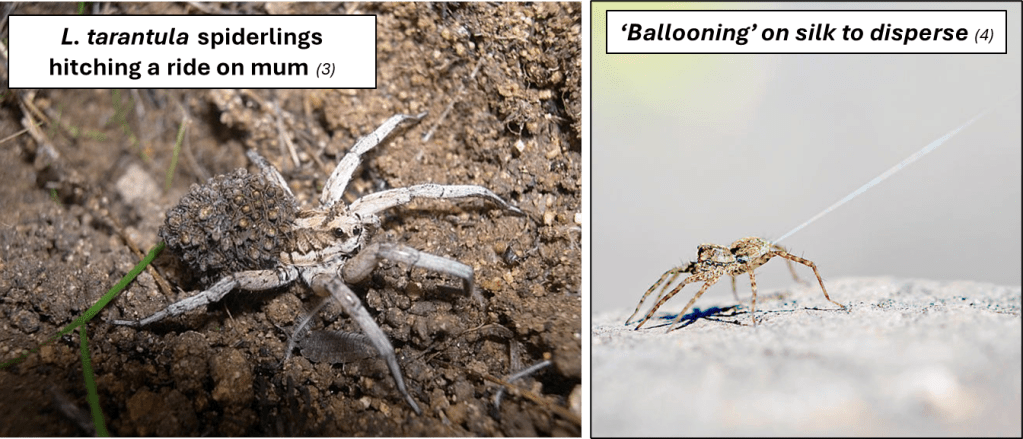
The pile of loose spiderlings isn’t terrible, but it isn’t now wolf spiders go about their nursery work either. Once the spiderlings have hatched, they will climb up onto the mother’s back and ride around on her for a while, protected, until they drop off to disperse on foot – or via ‘ballooning’. This is when a tiny spider throws a line of silk up into the air, and the combination of wind and electrostatic interactions between the silk & air will lift the spider up and away! This is really important for dispersing and for colonizing new areas – it’s how spiders can get to far away islands, or cleared / replanted crop fields. Tiny species can do this throughout life, but larger-bodied species only do it during their smaller juvenile stages.
This ‘Bus Of Mum’ situation is the source of some viral videos you might have seen described as ‘disco ball’ spider, or some misunderstandings about squashing spiders ‘releasing hundred of babies‘. Firstly – don’t squash spiders. Secondly – if a wolf spider female dies while she is carrying spiderlings, they will flee, and there can indeed be hundreds of them. The disco spider is a much nicer story, and happens because wolf spiders have a tapetum lucidum (reflective layer) in four of their eyes (the big front ones and a pair below), which can reflect direct light back at the observer. Swing a torch beam over a lawn at night and you may well see lots of little glittering specks – nocturnal wolf spiders on the hunt. This tapetum is present in baby wolf spiders too, so if a female is carrying lots of spiderlings, all looking around, she can be very glittery at the right angle!
We don’t have any L. tarantula native to the UK, although we do have lots of much smaller wolf spiders. You will see them a lot if you’re out and about (and looking down), running through the grass, basking on the side of plant pots or sunny rocks, and holding on tight to their papery white egg sacks. They’re harmless spiders that do a colossal amount of pest control for us.
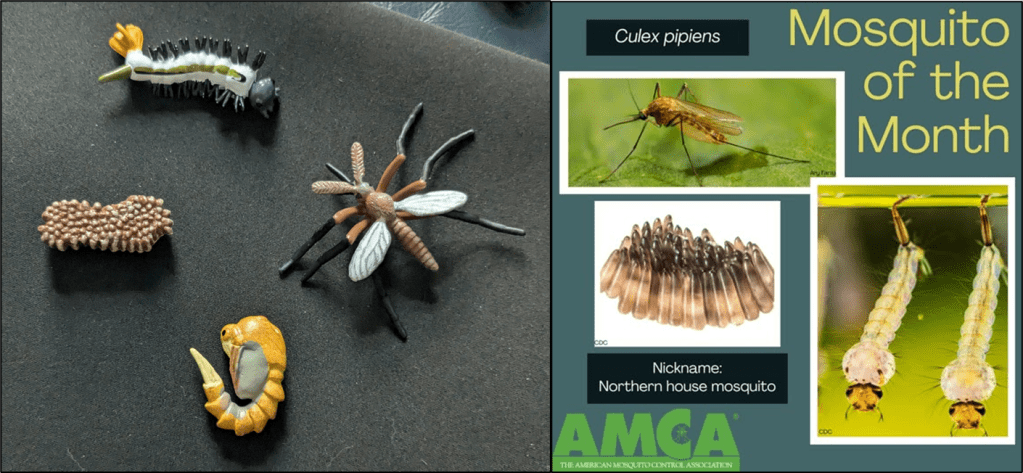
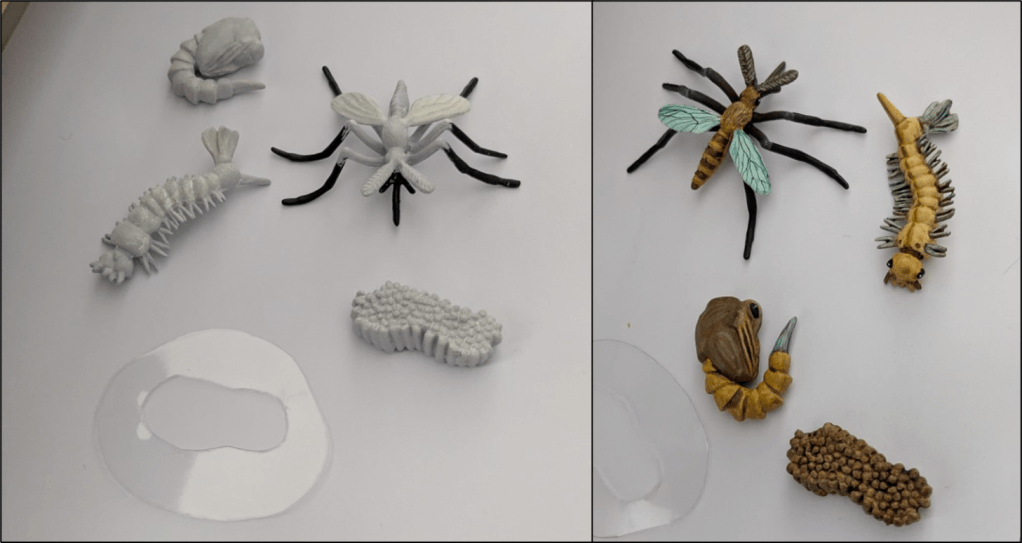
I’m not an expert in mosquitoes (just delicious to them, apparently; thanks skin chemistry), but when it comes to insects that folks are familiar with, I can’t just have the nice ones out. Given that the egg / larval stages of mosquitoes are very small, and mostly transparent, I mostly just wanted to a) make this one look fancier, b) repaint the larvae because I didn’t like the colours.
Decided to base it on Culiex pippiens, the common house mosquito. Possibly C. pipiens. f.molestus (yes, this is its name), the ‘London Underground’ mosquito, which is much more bitey than normal C. pipiens.
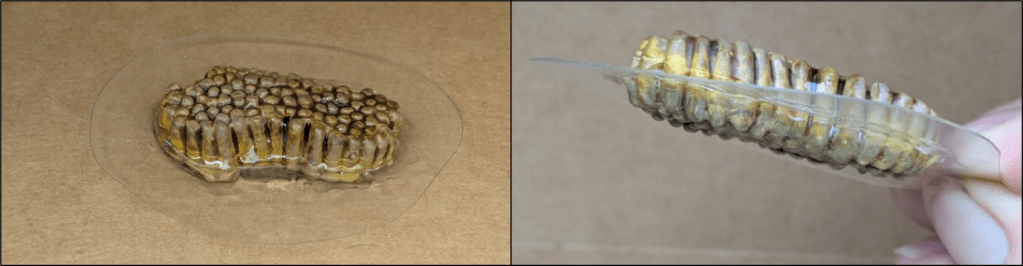
Mostly just a prime and repaint – although I wanted to see if I could make the eggs more clearly a floating egg ‘raft’. Also I absolutely did not get the wing venation correct; please do not come for me, Dipertists.
Traced and cut out the egg raft shape on some clear plastic, wedged the eggs in there, and used some UV-setting resin to seal everything up.
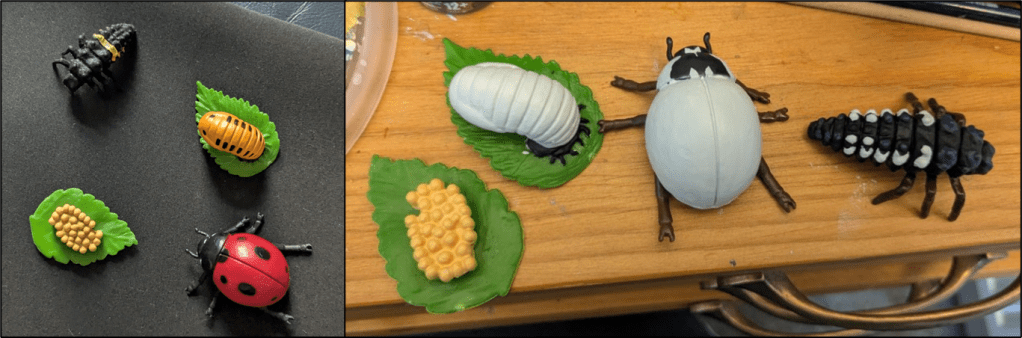
The 7-spot ladybird is one of our most recognizable ladybird species, and is probably the quintessential ladybird to many people. Red-orange, black legs, 7 black spots, two big white spots on the pronotum. It’s even the basis for the ladybird emoji 🐞🐞🐞 The lifecycle toys are clearly based on it, and aren’t anywhere near as escalatingly-weird as the bee ones are.
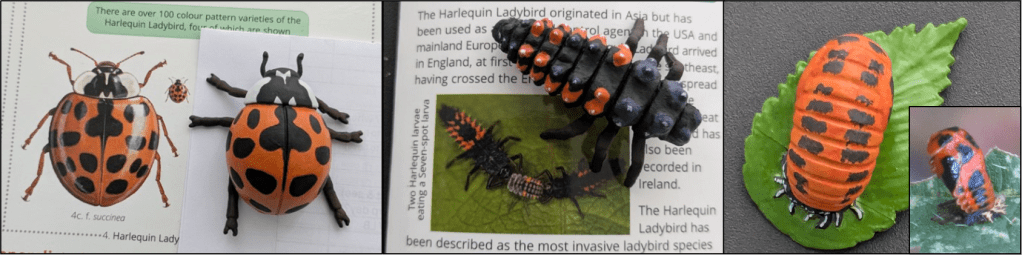
So why did I repaint mine to be a Harlequin Ladybird (Harmonia axyridis)? It’s not even a native species, and has caused documented problems for our native ladybirds.
Well, firstly, I will be doing a 7-spot life cycle repaint soon enough. But I think the existing schemes are (accidentally? Sort of?) meant to be harlequins – at least in the early stages, and it’s because of the sculpt of the pupae.
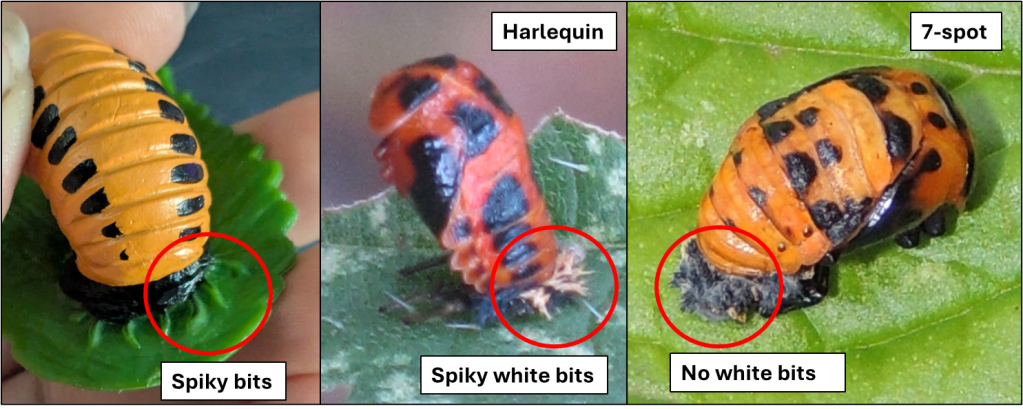
If you’ve never seen a ladybird larvae go into its pupae, it’s weirder than you think. Essentially the larvae fixes its bum down onto a suitable surface, then the pupal skin splits out of the old one. The old skin scrunches down to the base and ends up as a crumpled shed underneath the smooth pupae. Here’s a timelapse:
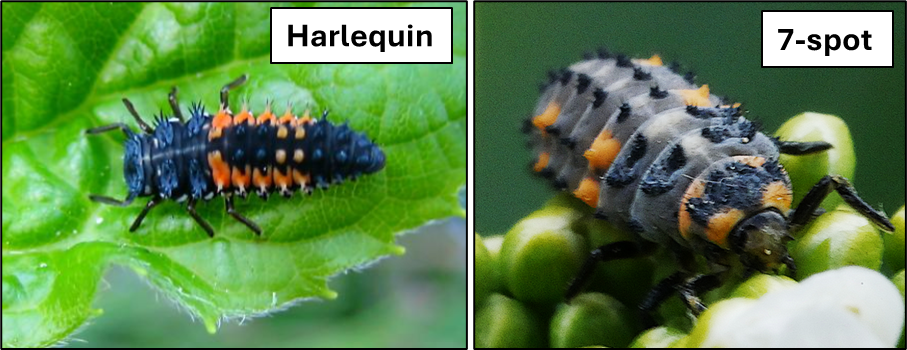
Since the leftover is a shed skin, you can still see some characteristics of the larvae that wore it. Harlequin larvae are very distinctive and have lots of long(ish) spiky bits on their backs, which are usually pretty visible on the bottom of their pupae too; 7-spot larvae don’t have these (and are also generally more grey in colour).
The ladybird lifecycle sculpt has quite long, spiky bits at the bottom of the pupae stage. (Not painted in the version I got, but there.)
This doesn’t mean it is a Harlequin, but the idea got in my brain and so I wanted this one to be H.axyridis. For my own outreach needs, Harlequins are large, distinctive, and very common across most of the UK (spreading into Scotland currently). While they aren’t native, they are definitely something that folks are going to encounter easily, and I do get a lot of questions about them.
There was less to do than for the red mason bee; mostly just prime, pick a colour pattern (including the brown legs of the adults – important diagnostic feature!), and then varnish repeatedly.
Since Harlequins are very polymorphic in their colouration, I went with the common f. succineapattern.
I am very pleased with these too! I do want to do a 7-spot version, but I’ll need to order a new one to pedantically repaint.
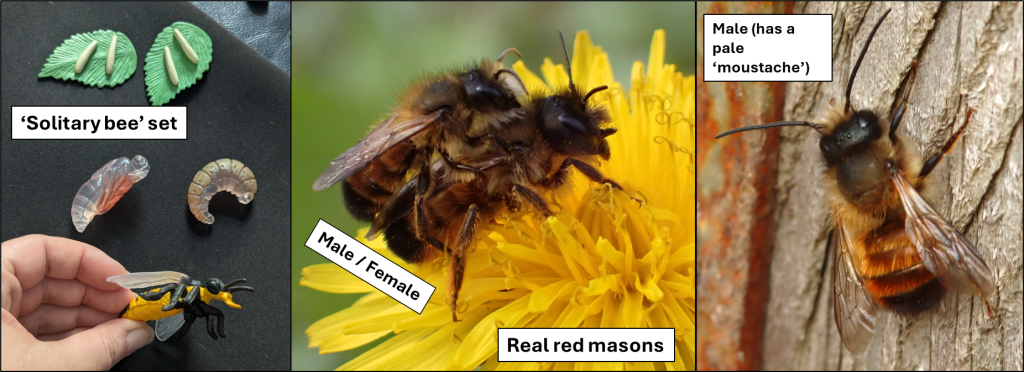
I talk a lot about bee hotels (sometimes even for work), and one of the the most common visitor to UK bee hotels is the Red Mason bee (Osmia bicornis). They’re a reddish / ginger solitary bee a little smaller than a honeybee, and the distinctively ‘horned’ females make use mud to make their nesting cells. They’ve got patchier distribution in Scotland, but do seem to be spreading into Northern areas. So a good candidate for a bee hotel user representative.
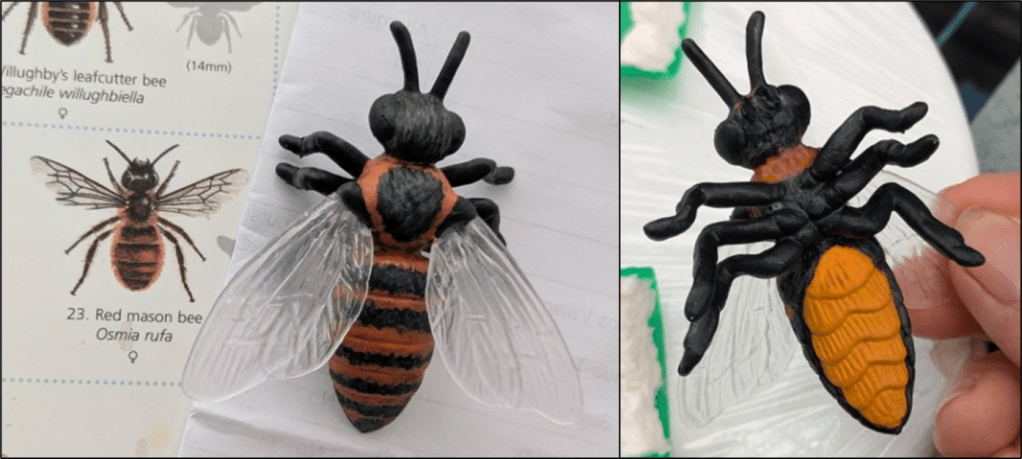
As I discussed earlier, there’s some work to do to make the easily-available lifecycle toys into what I want. The ones that arrived (above) came with 2x Long Leaf Eggs (no), slightly-shaded transparent larvae / pupae, and the sort of… beaked(?) bee sculpt, in a general yellow-black-stripy colour pattern. I want this to be a Red Mason bee, and to have some sort of ‘bee hotel’ element to it.
1) Trim the beak into the ‘horns’ of a female O.bicornis. The models are made of a rubbery plastic, so a pair of hobby clippers cut it easily. Once trimmed, coat the models in acrylic primer, so the new paint has a good surface to stick to, and repaint it. (Did I forget to take a photo of this part of the process? Of course.)
2) Go through the Big Box of Plastic Bits to find something that the larvae fit in, which can be made into ‘bee hotel’ tubes, and half of a cocoon. Trim everything to size, then faff around with papier-mâché / milliput to make: cell walls, pollen mass, egg. Wait for ages for it to dry. Fill in gaps that form when dry, because you forgot that papier-mâché shrinks.
3). Discover it is weirdly harder to paint a half-decent ‘bamboo tube’ texture than a bee. Paint everything anyway, and varnish several times. Hopefully the flexible plastic won’t crack the paint off with the primer / varnish combo, but we shall see.
I love a good outreach activity and (as the state of my shelves will attest) I really love a little model of something. It’s a great way to illustrate what you’re talking about, particularly when what you’re talking about is something a) small, b) unusual or potentially hard to visualize, and c) sequential, like life cycles. They’re like 3D diagrams, that you can pick up and prod.
Also, I am considerably better at making / adjusting little models than I am at any form of drawing. Making things out of powerpoint shapes can only take you so far.
So since I’m doing my own activities now, I have an excuse to up my collection of Cool Bug Models (up from the previous combo of ‘Things from the Halloween Section’, ‘Goth Tat (Realistic)’, and ‘Oddly-specific Museum Gift Shop Delights’). Into an internet rabbit hole I go, looking for models that are accurate (enough, or could be modified), representative of local critters (UK ideally), and viable on a self-employed budget.
There is… a lot going on.
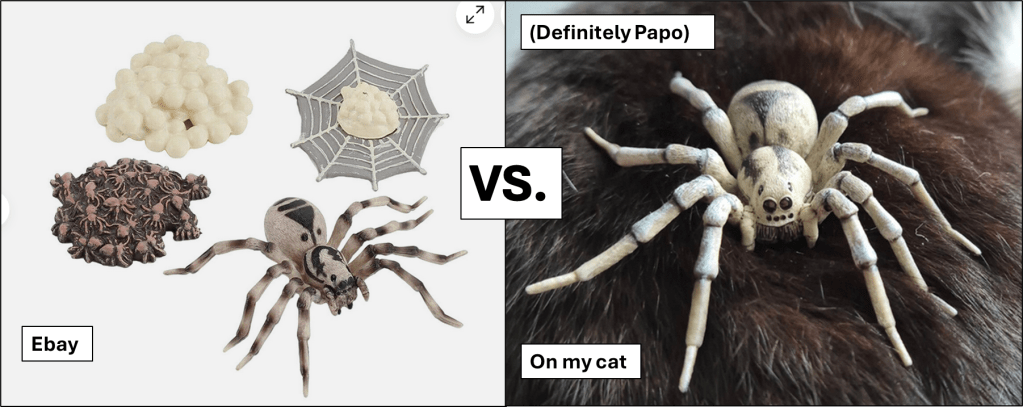
1. Plagiarism ahoy! I have no idea how you’d even start looking up the provenance of a 3D model design, but there are clearly a lot of knock-offs of the knock-offs, knocking-off. For example, I’m pretty sure that the spider in this ebay/unbranded ‘Spider Life cycle’ is a clone of the Papo ‘Tarantula’ (actually the Original Tarantula, the wolf spider Lycosa tarantula).
Also that’s… not how wolf spider eggs work. Or tarantula eggs. Or, really, any spider eggs at all – they lay eggs inside protective egg sacs (which can be really elaborate), not in A Heap, and certainly not in the middle of a web! The web is a hunting tool. Do not keep your babies in it.
2. Very America-centric. Bit of a peeve of mine for bug things in general, is that most insect models are based on bugs found in America. So many ‘butterfly’ and ‘moth’ life cycles are specifically the Monarch butterfly or Luna moth – and yes, they’re gorgeous and fascinating, but we don’t get them in the UK. We’re illustrating life cycles of very conspicuous and important types of critter, with species that kids will not see in the natural world around them. It’s disappointing, and I worry that it only adds to the idea that Wildlife Happens Elsewhere.
Weirdly, except for ladybirds. The 7-spot ladybird seems to be the Platonic Ideal Ladybird even for the US, even if they’ve only been present there since ~1950s and are an introduced species.
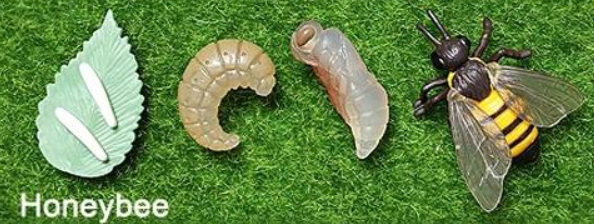
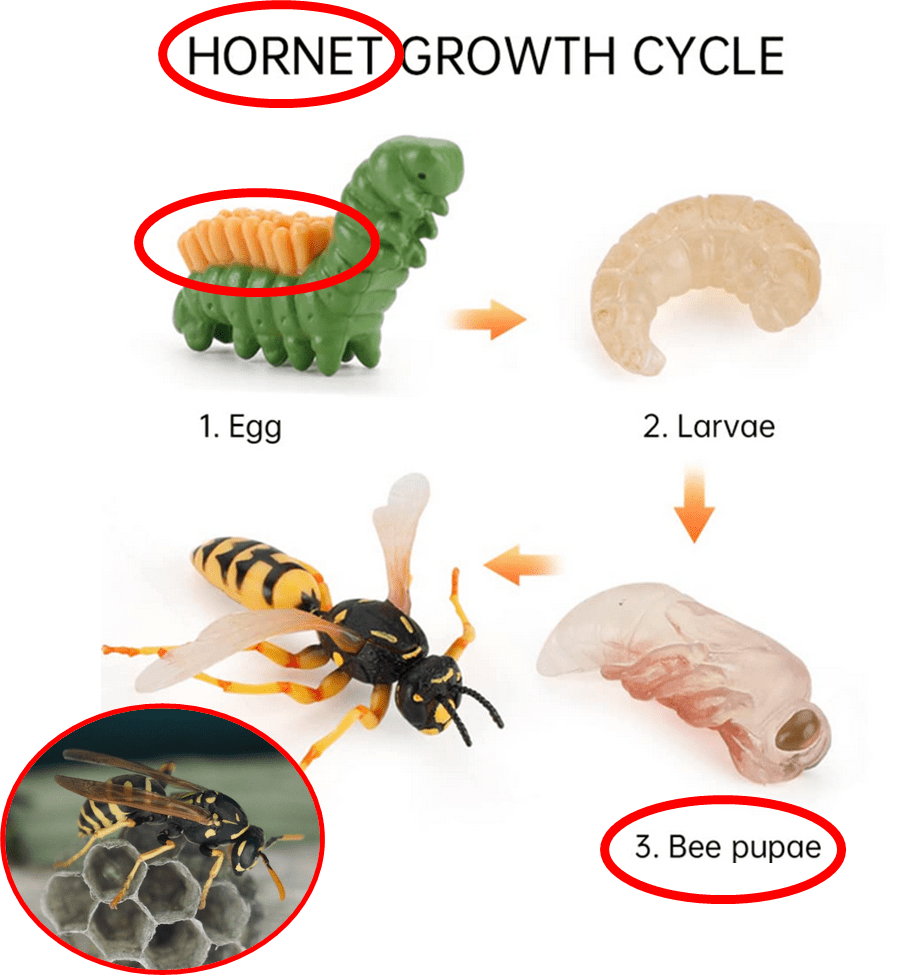
3. The Bee Randomiser. There are a few models of egg / larvae / adult bees used everywere, which honestly seem to be assigned randomly to each other as life cycles. Also one wasp (which I think is a Polistes paper wasp, not a parasitoid), and a very sad caterpillar (likely a parasitised hornworm). These proposed life cycles are… variable.
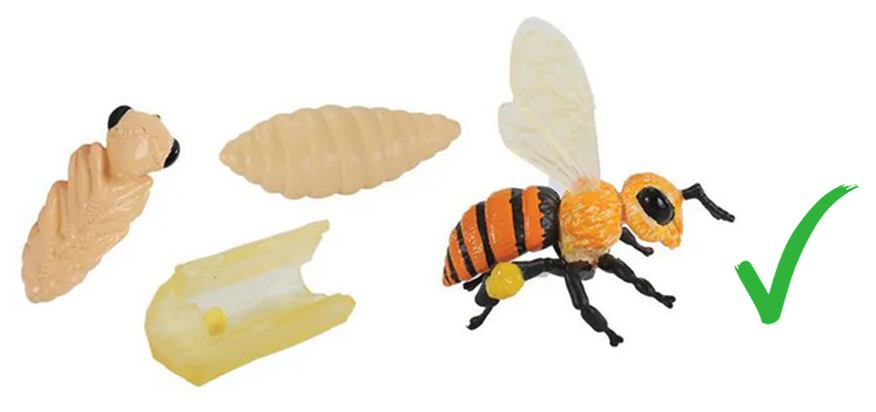
‘Insect Lore‘ honeybee life cycle. Wax cell for egg! Immature larvae fits in cell. Adult right shape (+ pollen baskets).
A bumblebee? Why are the eggs so long? Why are they loose on a leaf? These are the typical ‘larvae’ and ‘pupae’ sculpts, which are good, but just… around. Contextless. Nude?
The most common bee shape. Solitary bee? Doesn’t look chunky enough for bumblebee. Why is the egg so long and transparent? It’s in some sort of trough. Comb cell? Bee hotel?
<- No.
And finally, the most baffling combination I found:
SPIN THE BEE RANDOMISER!
These labels make no sense. Nothing to do with hornets. That is a parasitised hornworm caterpillar. The lumps coming out of it would be braconid parasitoid wasp larvae / cocoons, so 2 & 3 don’t need to exist. Adult is from a completely different Family of wasps (inset image of Polistes), looks nothing like a braconid, and has a completely different life cycle.
So. Other than adding another topic to my Oddly Specific Rants ensemble, what to do. I still want life cycle toys, but I have Opinions.
And there’s a whole load of tabletop miniature wargaming* crafting supplies across the room from my work desk…









 Gardens, bugs and science